Last updated: 30/09/26]
Let's address the elephant in the room. I'm a headshot photographer, so asking me what I think of AI headshots is a bit like asking a baker what he thinks of supermarket sliced bread. You can probably guess where I'm going.
But stick with me, because it's not quite what you'd expect. Some AI headshots are genuinely impressive, and I'd be lying if I said otherwise. AI imagery has its place, and used openly, it can be done with real credibility.
Where I draw the line is your profile photo. The picture that says "this is me" should actually be you.
Here's why.
The quick answer
AI headshots are cheap, quick and increasingly convincing, and they can be useful for creative or clearly illustrative images. But for a profile photo on LinkedIn, your website, a team page or a speaker bio, a real photograph is the better choice. A profile photo promises that this is what you look like. A real photo keeps that promise. An AI one only imitates it.
So, how do AI headshots work?
You upload a handful of selfies. The software studies your face, then produces new images of "you" in a nice suit, against a clean background, lit beautifully. Within minutes you've got dozens to pick from, for a fraction of what I'd charge.
Clever stuff. Can’t argue, it’s incredible.
This image is me. Or is it? I used Canva because the platform is very well known and needs little introduction. I used my phone for a bad selfie, snapped too close in poor light with a wall behind me. I uploaded it, made some style choices, and this is the result.
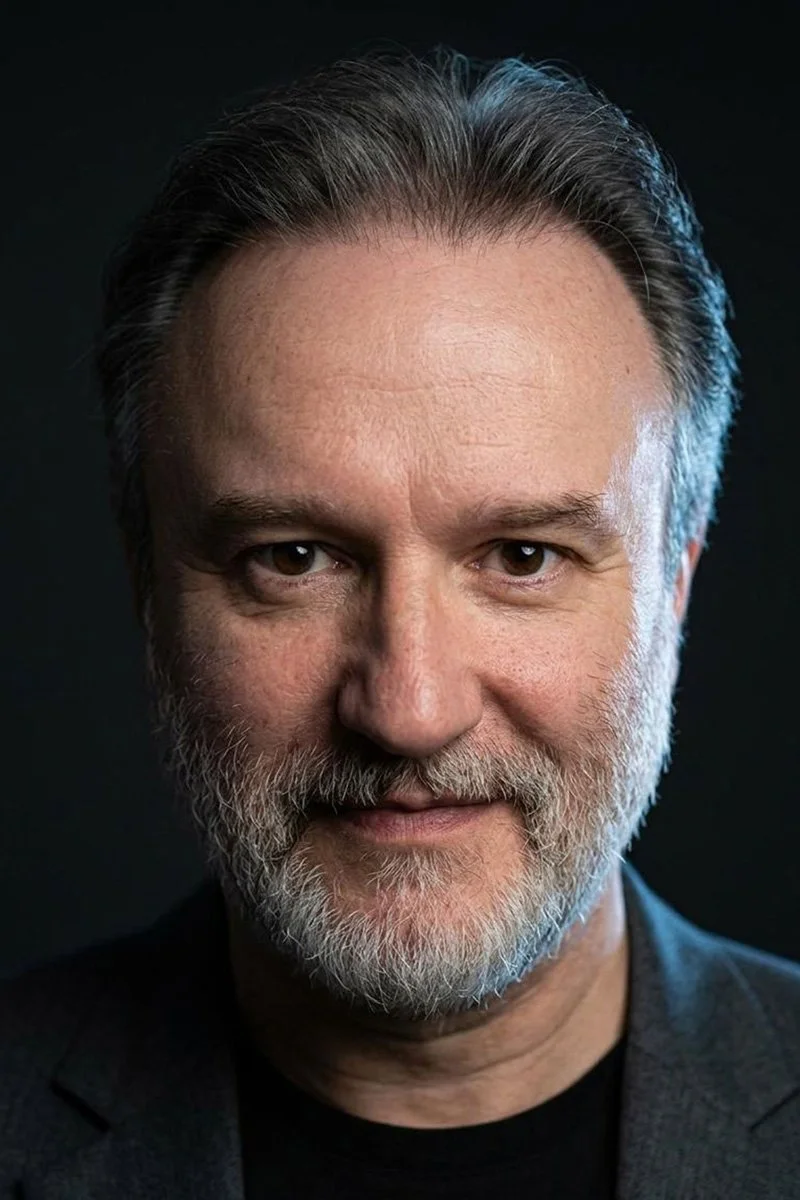
An AI image of Matthew Burch created by Canva
Credit where it's due
AI headshots do have things going for them, and I'm not going to pretend otherwise:
They're cheap. Much cheaper than a professional session.
They're fast. No booking, no diary juggling, no travel.
They're convenient. You can do it from the sofa in your pyjamas at midnight.
They beat a bad selfie. If the alternative is a cropped wedding photo with someone's shoulder still in it, an AI image will look more polished.
For some people, that's enough. I get it.
"But recruiters prefer AI headshots!" Do they, though?
You may have seen this one quoted. In June 2024, Ringover surveyed 1,087 US recruiters, and across five sets of photos they picked the AI headshot as their favourite 76.5% of the time. When asked to spot which were AI, they got it right only about 4 times out of 10.
Sounds like a knockout win for AI. But here's the bit that usually gets left out: the "real" photos in that study were collected from the participants themselves. They weren't professional headshots. So the test was really AI against people's own photos, not AI against a photographer who knows what they're doing.
And that second finding, that recruiters mostly can't tell the difference? For the companies selling AI headshots, that's the headline. For me, that's exactly the problem. If an image is convincing enough that people believe it's a photograph of you, but it isn't, it's quietly doing something rather different from what everyone assumes.
What does LinkedIn actually say about AI profile photos?
LinkedIn hasn't banned them. Its rule is simpler: you can use an illustration, a caricature or another artistic version of yourself, but your profile photo has to reflect your likeness. Its community policies also say not to use any image that isn't your likeness as your profile photo, and LinkedIn can remove photos that break the rules.
So an AI image that genuinely looks like you isn't against the rules. But "looks like you" is doing an awful lot of heavy lifting in that sentence, and it's exactly where AI images tend to wander off.
Why I draw the line at profile photos
Most images in business are there to illustrate something: a product, an idea, a mood. Nobody thinks a marketing graphic is a literal record of reality.
A profile photo is different. When someone looks at your LinkedIn picture or your face on the team page, they're assuming one simple thing: this is what this person looks like. They're using it to decide whether to trust you, whether to get in touch, and to spot you in a busy café when you meet.
Your headshot is your digital handshake. Would you send a stand-in to shake hands for you?
Then there's the meeting itself. On a video call, at a networking event, across the boardroom table, if you look noticeably different from your photo, even subtly, there's a little moment of "hang on" at exactly the point you want trust. Clients buy people, especially in professional services. Starting with something that isn't quite real isn't a great opener.
And there's you. Plenty of people who've used AI headshots tell me they never quite feel comfortable with them. It's them, but not quite. That's not a feeling you want every time you hit "send" on a proposal.
I've written more about why genuine images matter for businesses in Real Photos, Real Business.
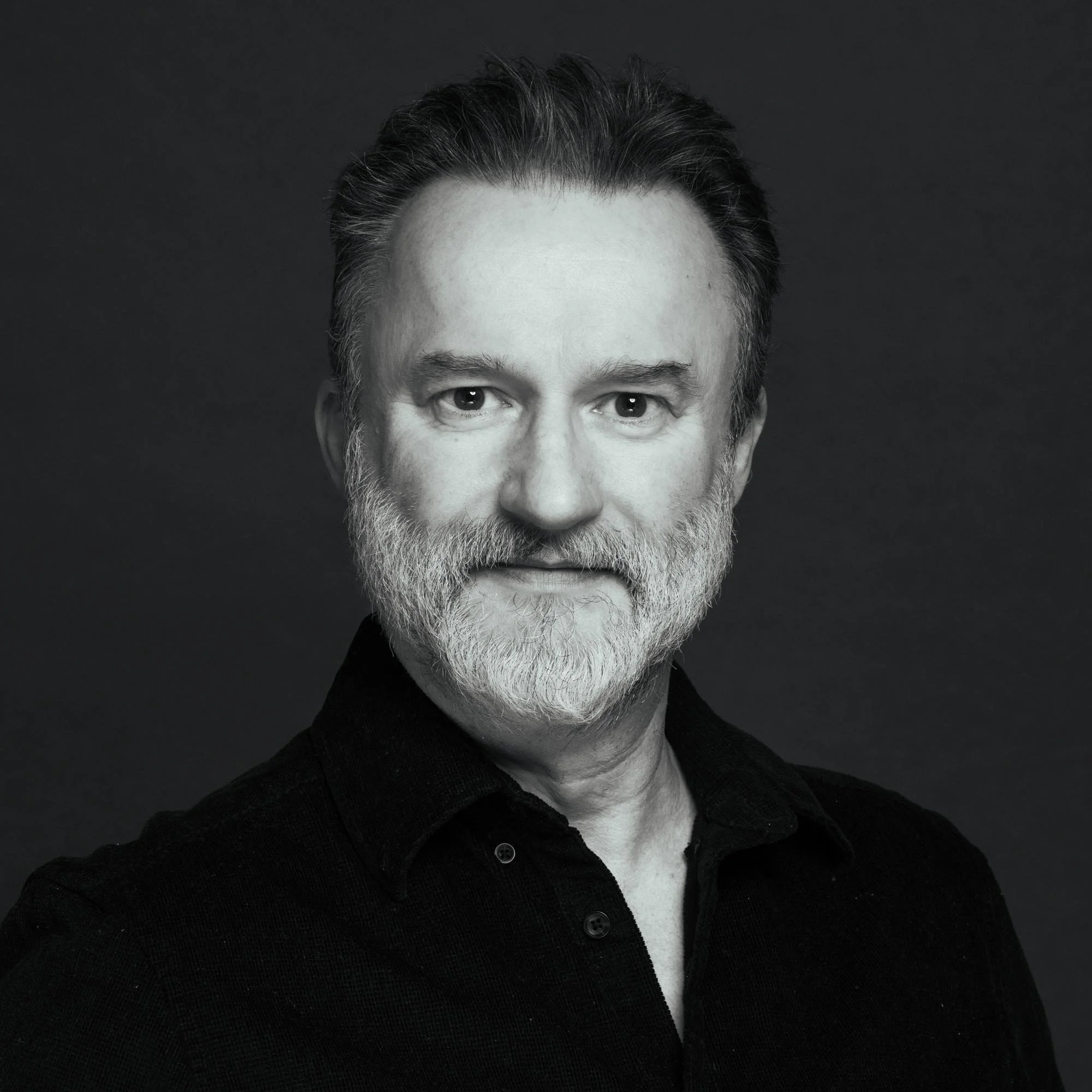
A real, studio shot headshot of Matthew Burch
What can a real photographer do that AI can't?
Capture your actual expression. AI gives you a pleasant, plausible face. I'm after your face: the way you smile when you've genuinely relaxed, the look that makes you recognisable to people who know you.
Direct you. Most people have no idea where to put their chin or what to do with their hands. That direction is where the best photos come from.
Show your real world. Your office, your team, your workshop. AI can invent a background; it can't show the place your clients will actually walk into. And because I'm a mobile photographer, I come to you, so the real world is right there.
Look after a nervous person. That part is entirely human. If that's you, have a read of I Hate Having My Photo Taken!
What about AI headshots for the whole team?
This is where AI companies are pushing hardest: matching team photos without anyone having to be photographed. And to be fair, the consistency argument is a good one. A patchy team page looks unprofessional.
But real photographs can be consistent too. When I photograph a team, I keep a record of the lighting, background and framing, so new starters can be photographed months later and still slot in alongside everyone else.
There are also some questions worth asking before you go the AI route:
Is everyone comfortable uploading their face to an AI service? Not everyone will be.
Where do those photos and face models end up, and how are they deleted?
What does a team of AI faces say about a business built on trust?
Where AI imagery genuinely has its place
I'm not anti-AI, honestly. Used openly, it's a useful creative tool, even with images of real people:
Creative marketing and campaigns that are obviously stylised
Illustrations and artwork for social media, presentations or events
Mock-ups to agree a look before a real shoot
Playful, themed content, like a seasonal post where nobody thinks it's real
Help with editing real photographs; I use some AI-assisted tools for things like removing a stray hair or tidying a background. It’s built into Adobe Photoshop and Lightroom.
That last one matters. There's a big difference between AI helping to edit a real photograph and AI inventing one from scratch.
My test is simple: is anyone being misled? If the audience knows it's AI, or it's obviously not meant to be a literal photograph, crack on. If people will assume it's really you and it isn't, that's where I get off the bus.
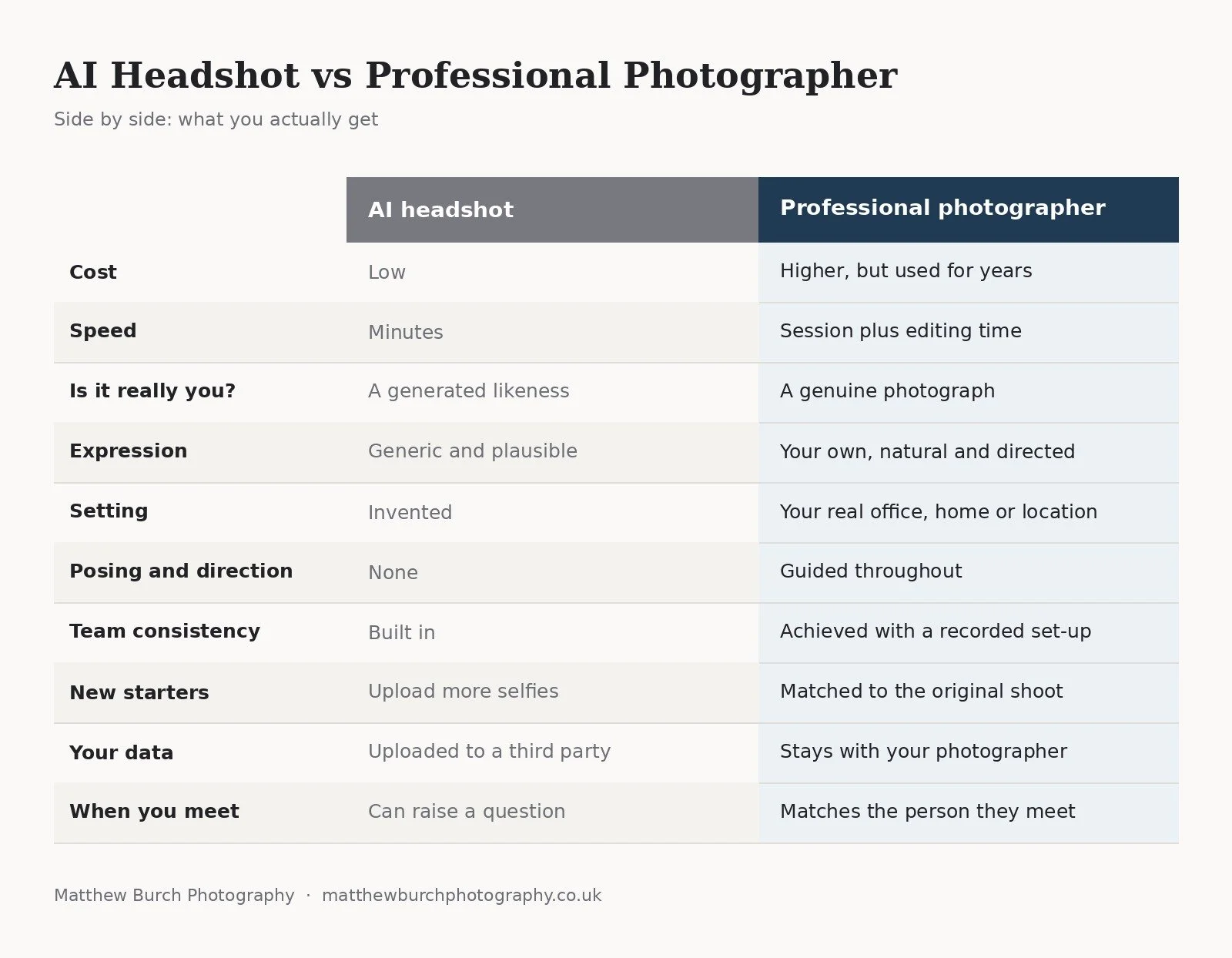
AI headshot vs professional photographer: side by side
So, which should you choose?
An AI image might suit you if:
You need something clearly creative or illustrative, not a profile photo
You're making mock-ups before a real shoot
It's for fun, and everyone's in on it
A real photograph is the better choice if:
It's your LinkedIn profile, website bio, team page or speaker profile
Your business runs on trust and relationships
People will see your photo before they meet you
You want a team page that's genuinely your team
You want a photo that feels like you, not a version of you
Frequently asked questions
Are AI headshots allowed on LinkedIn?
LinkedIn allows artistic renderings of yourself, but your profile photo must reflect your likeness, and it may remove photos that don't comply. An AI image that genuinely looks like you isn't banned; one that doesn't truly resemble you breaks the rules.
Can recruiters tell if a headshot is AI?
Often not. In Ringover's 2024 survey of US recruiters, participants correctly identified AI headshots only about 4 times in 10. But that's exactly why authenticity matters: people assume your profile photo is real.
Are AI headshots as good as professional photos?
The best AI headshots look polished, but they generate a likeness rather than photographing the real you. They can't capture your genuine expression, direct you, or show your real workplace.
Is an AI headshot cheaper than a photographer?
Yes, significantly. But a professional headshot gets used for years across LinkedIn, your website, proposals and email signatures, so the cost per use is small.
Should my company use AI headshots for the team page?
That's each business's call, but consider how staff feel about uploading their photos, where the data goes, and whether AI faces suit a brand built on trust. Real team headshots can be kept consistent, including for new starters.
Do photographers use AI?
Most photographers use AI-assisted tools to help retouch real photographs, which is different from generating an image from scratch. The final image is still a genuine photograph of you.
The short version
AI is here to stay, and in the right place it's a brilliant tool. But your profile photo isn't a creative asset. It's an introduction. When someone sees your face before they meet you, they deserve the real you, and you deserve a photo you can stand behind.
Real you, just better lit. That's the job.
If that sounds like what you're after, give me a call or drop me a message.
About the author
Matthew Burch is a mobile headshot and portrait photographer based in Farnham, Surrey, with 20 odd years' experience photographing individuals, business owners and corporate teams across Surrey, Hampshire, Berkshire, London and the UK.
Sources: